
Jeep Wrangler: GETTING TO KNOW YOUR VEHICLE / ROOF LUGGAGE RACK — IF EQUIPPED
NOTE:
Roof rack applications are for Hard Top models ONLY.
The load carried on the roof, when equipped with a luggage rack, must not exceed 100 lb (45 kg), this includes the weight of the crossbars, and it should be uniformly distributed over the cargo area.
Crossbars should always be used whenever cargo is placed on the roof rack. Check the straps frequently to be sure that the load remains securely attached.
NOTE:
Crossbars can be purchased at an authorized dealer through Mopar® parts.
External racks do not increase the total load carrying capacity of the vehicle. Be sure that the total occupant and luggage load inside the vehicle, plus the load on the luggage rack, do not exceed the maximum vehicle load capacity.
WARNING!
Cargo must be securely tied down before driving your vehicle. Improperly secured loads can fly off the vehicle, particularly at high speeds, resulting in personal injury or property damage. Follow the roof rack cautions when carrying cargo on your roof rack.
CAUTION!
- To avoid damage to the roof rack and vehicle, do not exceed the maximum roof rack load capacity. Always distribute heavy loads as evenly as possible and secure the load appropriately.
- Long loads, which extend over the windshield, should be secured to both the front and rear of the vehicle.
- Place a blanket or other protection between the surface of the roof and the load.
- Travel at reduced speeds and turn corners carefully when carrying large or heavy loads on the roof rack. Wind forces, due to natural causes or nearby truck traffic, can add sudden upward lift. It is recommended to not carry large flat loads, such as wood panels or surfboards, which may result in damage to the cargo or your vehicle.
- Load should always be secured to crossbars first, with tie down loops used as additional securing points if needed. Tie loops are intended as supplementary tie down points only. Do not use ratcheting mechanisms with the tie loops. Check the straps frequently to be sure that the load remains securely attached.
 Cargo Area Features
Trail Rail Cargo Organizer — If Equipped
If your vehicle is equipped with the Trail Rail
system, a rail will be found built into the floor on
either side of the cargo area...

Other information:
Jeep Wrangler 2018-2026 Owners Manual: Axle Lock (Tru-Lok) Front And Rear — If Equipped
The AXLE LOCK switch is located on the instrument panel (to the right of the steering column). Axle Lock Switch Panel This feature will only activate when the following conditions are met: Ignition in RUN position, vehicle in 4WD Low. Vehicle speed should be 10 mph (16 km/h) or less...
Jeep Wrangler 2018-2026 Owners Manual: Amazon Alexa Skill — If Equipped
Enjoy the convenience of using your voice to command your vehicle with Amazon Alexa! With Amazon Alexa, you can connect to your vehicle and remotely access key services and features. If your vehicle is equipped with Uconnect Navigation, you can send a destination directly to your vehicle using Alexa...
Categories
- Manuals Home
- Jeep Wrangler Owners Manual
- Jeep Wrangler Service Manual
- SERVICING AND MAINTENANCE
- 2.0L Engine and 3.6L Engine
- SiriusXM® Satellite Radio Mode — If Equipped
- New on site
- Most important about car
To Unlock From The Driver or Passenger Side
With a valid Passive Entry key fob within 5 ft (1.5 m) of the door handle, grab the handle to unlock the vehicle. Grabbing the driver’s door handle will unlock the driver door automatically. Grabbing the passenger door handle will unlock all doors and the swing gate automatically.
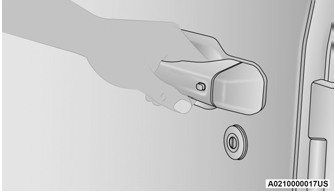
Grab The Door Handle To Unlock
