
Jeep Wrangler: TECHNICAL SPECIFICATIONS / WHEEL AND TIRE TORQUE SPECIFICATIONS
Proper lug nut/bolt torque is very important to ensure that the wheel is properly mounted to the vehicle. Any time a wheel has been removed and reinstalled on the vehicle, the lug nuts/ bolts should be torqued using a properly calibrated torque wrench using a six sided (hex) deep wall socket.
TORQUE SPECIFICATIONS
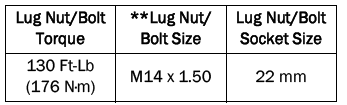
**Use only authorized dealer recommended lug nuts/bolts and clean or remove any dirt or oil before tightening.
Inspect the wheel mounting surface prior to mounting the tire and remove any corrosion or loose particles.
Spare Tire Torque Specifications
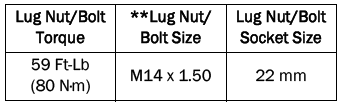
**Use only authorized dealer recommended lug nuts/bolts and clean or remove any dirt or oil before tightening.
Spare tire torque is for the spare tire carrier located on the swing gate.
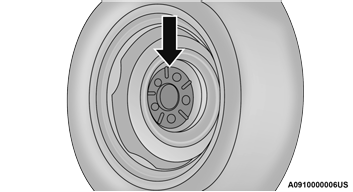
Wheel Mounting Surface
Tighten the lug nuts/bolts in a star pattern until each nut/bolt has been tightened twice. Ensure that the socket is fully engaged on the lug nut/ bolt (do not insert it halfway).
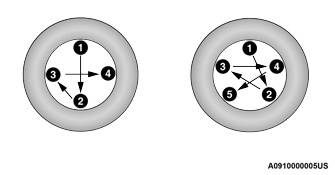
Torque Patterns
After 25 miles (40 km), check the lug nut/bolt torque to be sure that all the lug nuts/bolts are properly seated against the wheel.
WARNING!
To avoid the risk of forcing the vehicle off the jack, do not tighten the lug nuts/bolts fully until the vehicle has been lowered. Failure to follow this warning may result in personal injury.
 BRAKE SYSTEM
Your vehicle is equipped with dual hydraulic
brake systems. If either of the two hydraulic
systems loses normal capability, the remaining
system will still function...
 FUEL REQUIREMENTS — GASOLINE ENGINE
While operating on gasoline with the required
octane number, hearing a light knocking sound
from the engine is not a cause for concern.
However, if the engine is heard making a heavy
knocking sound, see a dealer immediately...
Other information:
Jeep Wrangler 2018-2026 Owners Manual: Removing The Hard Top
Remove both front panels. Open both front doors. Using the provided #50 Torx head driver and ratchet, remove the two Torx head screws that secure the hard top at the B-pillar (near the top of the front doors). Step Three Remove the six Torx head screws that secure the hard top to the vehicle (along the interior bodyside — three screws on each side) using the #50 Torx head driver...
Jeep Wrangler 2018-2026 Owners Manual: Cooling System
WARNING! You or others can be badly burned by hot engine coolant (antifreeze) or steam from your radiator. If you see or hear steam coming from under the hood, do not open the hood until the radiator has had time to cool. Never open a cooling system pressure cap when the radiator or coolant bottle is hot...
Categories
- Manuals Home
- Jeep Wrangler Owners Manual
- Jeep Wrangler Service Manual
- The ASSIST and SOS Call Buttons On Your Rearview Mirror Or Overhead Console
- SERVICING AND MAINTENANCE
- WARNING LIGHTS AND MESSAGES
- New on site
- Most important about car
Basic Voice Commands
The basic Voice Commands below can be given at any point while using your Uconnect system. Push the VR button on the steering wheel. After the beep, say:
“Cancel” to stop a current voice session. “Help” to hear a list of suggested Voice Commands. “Repeat” to listen to the system prompts again.