
Jeep Wrangler: Bulb Replacement / LED Front Fog Lamp
If your vehicle is equipped with LED fog lamps they are replaced as an assembly.
Rear Tail, Stop, Turn Signal, And Backup Lamp
See below steps to replace:
- Remove interior trim panel cap to access
single retaining screw for tail lamp
assembly.
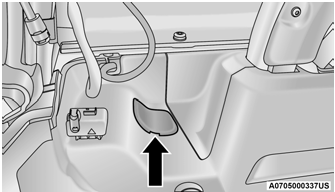
Trim Cap
- Remove retaining screw and disconnect
electrical connector, then remove tail lamp
assembly from the vehicle.
NOTE:
If necessary, push in on the assembly tab located inboard behind the lamp housing.
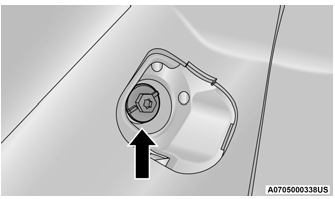
Retaining Screw
- Remove the three screws from assembly
bracket to access bulb sockets.
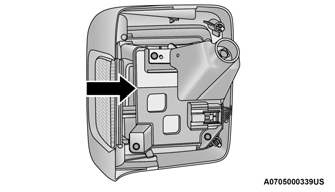
Assembly Bracket
- Rotate the appropriate socket a quarter turn counterclockwise, then remove it from the housing.
- Pull the bulb straight from the socket to replace.
Center High Mounted Stop Lamp (CHMSL)
The stop lamp is mounted on a bracket that extends upward from the swing gate behind the spare tire. If service is needed, obtain the LED Assembly from an authorized dealer.
See below steps to replace:
- Remove the spare tire.
- Remove the screws holding the tire carrier cover.
- Remove two screws from lamp assembly and disconnect electrical connector.
License Plate Lamps
See an authorized dealer to replace LED lamps.
NOTE:
To install a new bulb, reverse the procedure above. When installing the new bulb, care should be taken to not allow bare skin to come in contact with the bulb.
 Replacement Bulbs
NOTE:
See an authorized dealer for LED bulb replacement.
NOTE:
Lens fogging can occur under certain atmospheric
conditions. This will usually clear as
atmospheric conditions change to allow the
condensation to change back into a vapor...
 TIRES
TIRES
..
Other information:
Jeep Wrangler 2018-2026 Owners Manual: Axle Lock (Tru-Lok) Front And Rear — If Equipped
The AXLE LOCK switch is located on the instrument panel (to the right of the steering column). Axle Lock Switch Panel This feature will only activate when the following conditions are met: Ignition in RUN position, vehicle in 4WD Low. Vehicle speed should be 10 mph (16 km/h) or less...
Jeep Wrangler 2018-2026 Owners Manual: AutoStick
AutoStick is a driver-interactive transmission feature providing manual shift control, giving you more control of the vehicle. AutoStick allows you to maximize engine braking, eliminate undesirable upshifts and downshifts, and improve overall vehicle performance...
Categories
- Manuals Home
- Jeep Wrangler Owners Manual
- Jeep Wrangler Service Manual
- Programming HomeLink® To A Garage Door Opener
- Turning FCW On Or Off
- SERVICING AND MAINTENANCE
- New on site
- Most important about car
Automatic Headlights — If Equipped, Lights-On Reminder
Automatic Headlights
This system automatically turns the headlights on or off according to ambient light levels. To turn the system on, rotate the headlight switch clockwise to the last detent for automatic headlight operation. When the system is on, the headlight time delay feature is also on. This means the headlights will stay on for up to 90 seconds after you place the ignition into the OFF position. To turn the automatic system off, move the headlight switch out of the AUTO position.
