
Jeep Wrangler: Supplemental Restraint Systems (SRS) / Front Air Bag Operation
Front Air Bags are designed to provide additional protection by supplementing the seat belts. Front air bags are not expected to reduce the risk of injury in rear, side, or rollover collisions. The front air bags will not deploy in all frontal collisions, including some that may produce substantial vehicle damage — for example, some pole collisions, truck underrides, and angle offset collisions.
On the other hand, depending on the type and location of impact, front air bags may deploy in crashes with little vehicle front-end damage but that produce a severe initial deceleration.
Because air bag sensors measure vehicle deceleration over time, vehicle speed and damage by themselves are not good indicators of whether or not an air bag should have deployed.
Seat belts are necessary for your protection in all collisions, and also are needed to help keep you in position, away from an inflating air bag.
When the Occupant Restraint Controller (ORC) detects a collision requiring the front air bags, it signals the inflator units. A large quantity of non-toxic gas is generated to inflate the front air bags.
The steering wheel hub trim cover and the upper passenger side of the instrument panel separate and fold out of the way as the air bags inflate to their full size. The front air bags fully inflate in less time than it takes to blink your eyes. The front air bags then quickly deflate while helping to restrain the driver and front passenger.
 Driver And Passenger Front Air Bag Features
The Advanced Front Air Bag system has
multistage driver and front passenger air bags.
This system provides output appropriate to the
severity and type of collision as determined by the Occupant Restraint
Controller (ORC), which
may receive information from the front impact
sensors (if equipped) or other system
components...
 Occupant Classification System (OCS) — Front Passenger Seat
The Occupant Classification System (OCS) is
part of a Federally regulated safety system for
this vehicle. It is designed to activate or
deactivate the Passenger Advanced Front Air
Bag depending on the occupant’s seated
weight...
Other information:
Jeep Wrangler 2018-2026 Owners Manual: VEHICLE LOADING
CERTIFICATION LABEL As required by National Highway Traffic Safety Administration regulations, your vehicle has a certification label affixed to the driver's side door or pillar. This label contains the month and year of manufacture, Gross Vehicle Weight Rating (GVWR), Gross Axle Weight Rating (GAWR) front and rear, and Vehicle Identification Number (VIN)...
Jeep Wrangler 2018-2026 Owners Manual: IF YOUR ENGINE OVERHEATS
If the vehicle is overheating, it will need to be serviced by an authorized dealer. In any of the following situations, you can reduce the potential for overheating by taking the appropriate action. On the highways — slow down. In city traffic — while stopped, shift transmission into NEUTRAL, but do not increase engine idle speed...
Categories
- Manuals Home
- Jeep Wrangler Owners Manual
- Jeep Wrangler Service Manual
- Programming HomeLink® To A Garage Door Opener
- Jack Location
- Service 4WD Warning Light — If Equipped
- New on site
- Most important about car
Manual Seat Height Adjustment
The driver's seat height can be raised or lowered by using the ratcheting handle, located on the outboard side of the seat. Pull upward on the handle to raise the seat, push downward on the handle to lower the seat. Several strokes may be necessary to achieve the desired position.
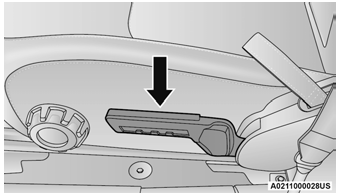
Seat Height Adjustment
